








How to write emails with AI that still sound like you
We compared 189 of my emails from before ChatGPT with the ones our agents draft for me. AI detectors were the wrong test. Measuring my style, giving the AI real examples and checking for leaks and promises worked.
 Ben PowerCo-founder
Our agents draft a lot of my email. I read every draft and I send it myself, but the question kept nagging: do these read as AI?
So we tested it. We took 189 emails I wrote between 2020 and 2022, before ChatGPT existed, and compared them with emails our agents had drafted for me. Here is what we tried, what failed, and what we do now.
Online AI detectors misfire on real people
We started with the obvious tools. We ran ten non-confidential emails through three online detectors: five of mine from before AI, five written by agents.
- GPTZero rated three of my genuine pre-AI emails 100% AI. I wrote them in 2021 and 2022.
- ZeroGPT called everything human. It tells you nothing.
- Sapling reacted to bullet lists, and said so on screen. A tidy list pushed one agent email to 59%.
If a detector says a person who definitely wrote an email is a robot, no amount of editing will fix that. You would be editing towards a number that has nothing to do with who wrote it.
Running detectors on our own machine
We did not want to paste real client email into someone else's website, so we ran three detectors on a Mac, with no email leaving it: one that compares how two small open AI models predict the text, and two free classifiers trained to spot AI writing.
All three picked up generic, fact-free AI text. Both classifiers flagged every one of our ten control emails, written in a default-assistant style, and the model-comparison one flagged half. But they passed specific emails whoever wrote them, and one classifier flagged about a fifth of my own emails (22%), mostly short ones of around 50 words with a link and a sign-off.
That is the lesson. A detector measures how generic text is, not who wrote it. An email with real names, links and figures in it scores as human, even from an agent. An empty email scores as AI, even from me.
If you want to try one, the classifiers are free to download and run on an ordinary laptop with a little Python. Score your own old emails first: if the detector flags a fifth of them, you know what its flags are worth. Scores are unreliable under about 80 words, and most emails are that short.
What actually separated my emails from the agents'
Since detectors could not help, we measured style instead. We counted things in my 189 old emails and in the agent drafts.
- Openers. I start sentences with "I", "Let me know", "We" and "If". Agents start them with "The", "It" and "There".
- Paragraphs. Mine are usually one sentence. Agents wrote balanced little blocks.
- Joins. I link thoughts with a spaced hyphen. Agents almost never did (1.6 per 100 words for me, 0.1 for them).
- Rhythm. My sentence lengths are uneven: a long one that runs on, then "Should be fine." Agents wrote tidy, even sentences.
- Small marks. Exclamation marks in about half my emails, slashes like 12:30/1pm, brackets, the odd :). Agents had almost none.
- Size. Agents wrote emails twice as long, with twice the bullets and twice the colons.
The most useful finding was about our own advice. The old guide told agents to write "short, punchy sentences". That made it worse. I am conversational, not clipped. The agents cut the small words out and produced exactly the tidy, compressed sentences that give AI away.
A better test: a blind judge
Detector scores did not separate good drafts from bad ones, so we built a different test. A strong AI model is shown six of my real emails, then one more email, and asked how likely it is that I wrote it. It does not know which are real.
We ran it on 20 emails of mine that the writers had never seen. Judged as me:
| Writer | Judged as Ben |
|---|---|
| Old guide | 2 of 20 |
| New guide plus six real examples | 18 of 20 |
| Old drafts rewritten with the new guide | 19 of 20 |
| My real emails | 19 of 20 |
Most of the gain came from the measured rules above. Putting real examples of my emails in the prompt helped on top of that, and the stronger model imitated better than the cheaper one. It is not perfect: if the judge sees my real email next to the AI version, it still picks mine every time. A recipient never has the original, so one email at a time is the fairer test.
The check that mattered most had nothing to do with voice
During this work an agent drafted a reply to a client from a private note I had given it. It put the note into the email itself. The draft mentioned another project the client knew nothing about. It also offered meeting times that depended on someone else's reply, which had not come.
It also read stiffly, but fixing the tone would not have fixed the real problem. A voice score cannot tell what the recipient already knows.
So every draft now goes through an automatic check before it reaches Gmail:
- Leaks block the draft. Anything the recipient has not been told and should not see: my instructions, the agent's reasoning, other people's details, projects that appear only in the note.
- Promises block the draft. A time, date, fee or deliverable that depends on something still unresolved. "I'll come back to you with some times once I have that" is fine. Naming the times is not.
- Voice gives a warning. If the odds that I wrote it fall below 50%, it lists up to three specific giveaways.
It costs about $0.004 per email.
What to take from this
- Give the AI your real emails as examples. We measured 189 of my emails from before AI to write the rules, then put six of them in front of the AI as examples every time it drafts.
- Tell it your instruction is background, not content. The note you give an AI is for the AI. Only what the recipient should know goes in the email.
- Measure your own style. Count openers, paragraph length, punctuation. Do not trust adjectives like "friendly but professional".
- Check for leaks and promises, not just tone. Those are the mistakes that cost you.
- Do not chase detector scores. They flag real people, and they pass specific writing from anyone.
Want to try it? Download the prompt we'd start from (Markdown). Connect your AI to your email, run it, and it reads your sent emails from before ChatGPT and writes your voice guide. Read the note at the top first.
If your AI emails are specific, short and say only what the reader needs, they will read as yours. Read every one before it goes.
More from the Content Hub
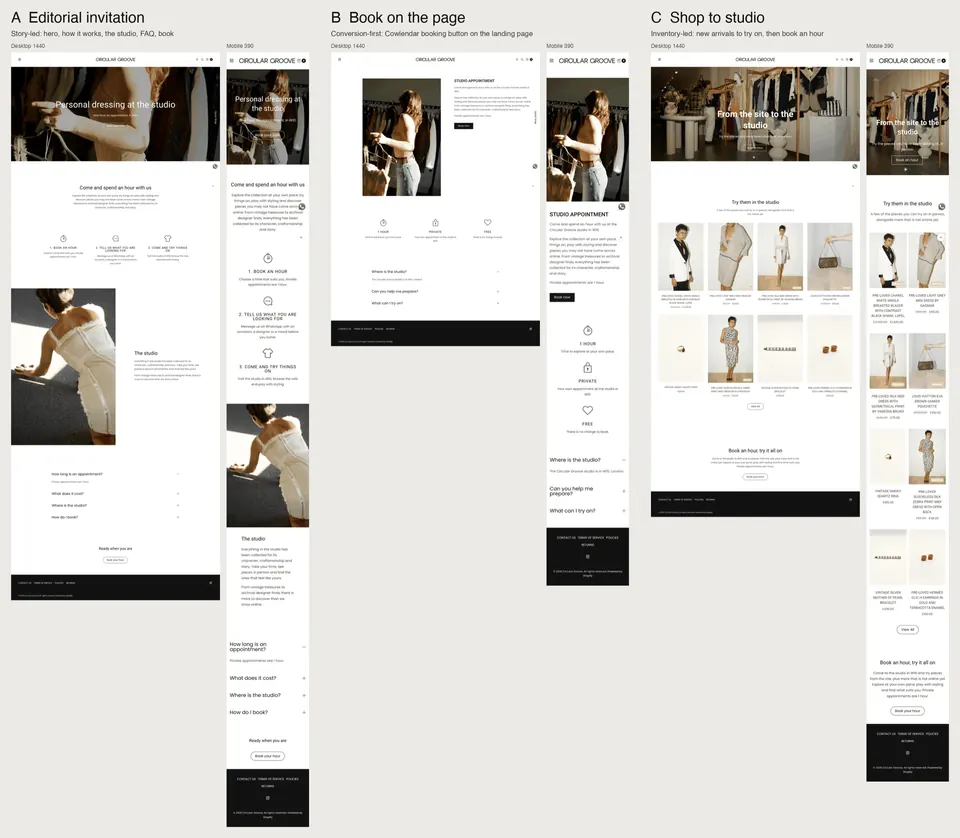 How I built a booking page with AI tools, round by roundA studio booking page for a London vintage store, mocked up with Claude Code in 1 hour 42 minutes and then changed with the owner's own words. What the AI showed me each round, what I said back, and where it went wrong.Read the note
 How we built 136 FAQs in minutes: the power of Cursor + Webflow MCPHow Cursor and Webflow's MCP server helped us create 136 FAQs for our website in minutes, and what we did first to make it work.Read the note
 How to make a free websiteYou can make a free website and own it. Here's how we built our own, pacing.agency, with AI coding tools and hosting that can cost nothing, step by step, and the parts that still cost money.Read the note
Get the next one in your inbox.
Occasional emails, only when there's something worth reading. You can unsubscribe from any of them.
Ready to get started?
Book in a free video call, a meeting in and around London, or even a running or climbing session.
- A 15-minute callYour goals, your challenges, and whether we're the right fit.
- A 1-hour discovery callWe dig into your numbers. Worth a hundred emails.
- A concrete planAds, a custom build or both, as a one-off project or ongoing.