









Why move your website from WordPress to Webflow or Astro?
Migrations might be a pain, but longer term they're worth it.
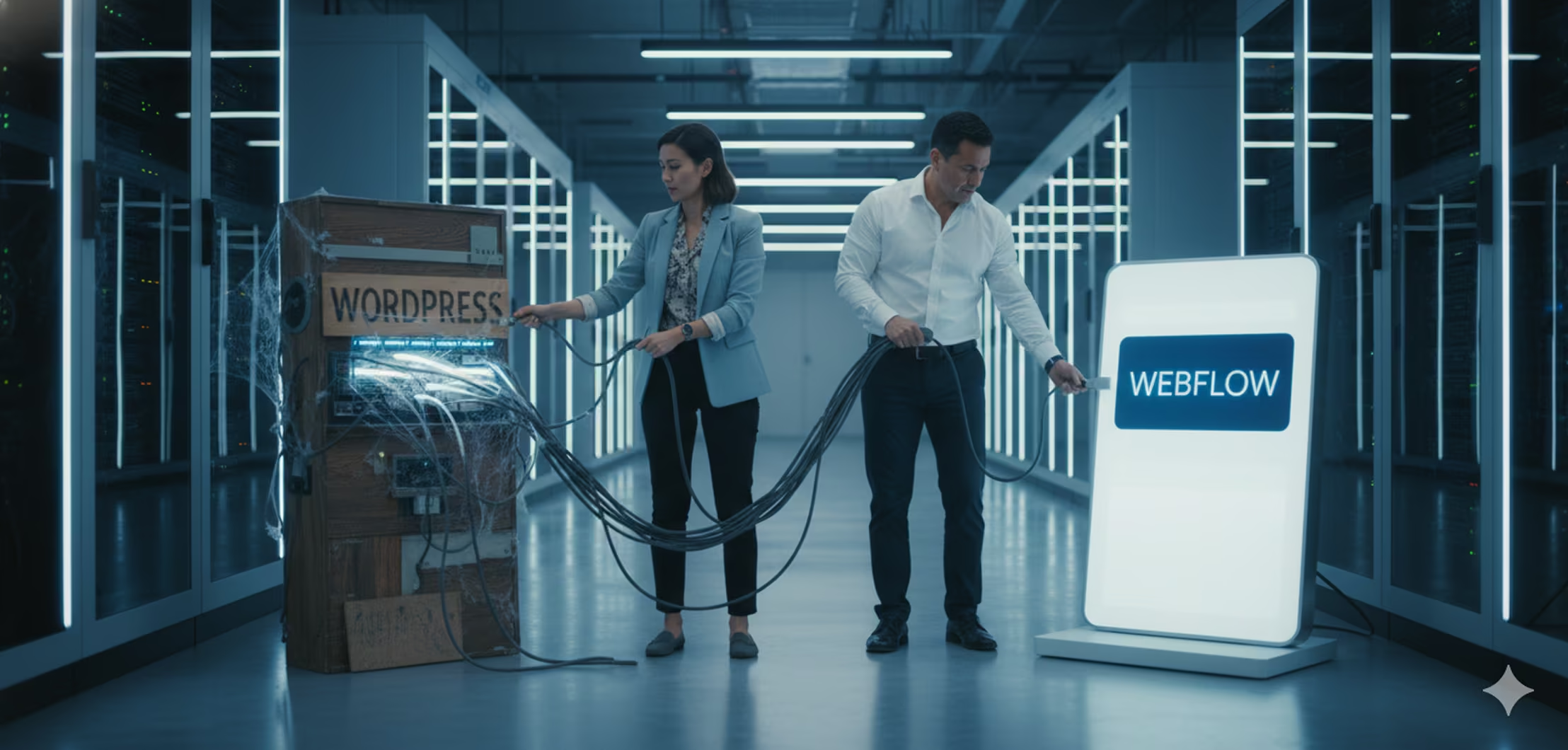
You've probably been sent this link by someone at Pacing and likely don't want to read a whole blog about it. We don't work with WordPress, so we move sites off it, to Webflow or Astro, whichever suits the site. We're a Webflow Certified Partner, so most of this post is about Webflow.
No problem, below are the highlights and if you want to know more, the detail is further down.
- Faster because no plugins
- Cleaner code = easier to manage and easier to crawl (and faster again)
- More responsive, better user experience
- Go live quicker, with easier QA
- Hosting included so all under one roof
- More built-in features (localisation, analytics, personalisation, AI-powered tests and more, depending on your plan)
Still with us?
Great, so here's a little more detail.
Faster because no plugins
Plugins are pieces of code you add to a website to integrate a feature you want, they're built by different companies who will all have slightly different ways of doing things.
So, when you start adding lots of plugins, the code becomes more difficult to read because you're adding lots of different pieces of code on top of each other, which takes CPUs longer to load.
Some of these plugins also don't play nicely together, it's not uncommon to install one, only to find another is broken.
Cleaner code
The lack of plugins therefore makes your website's code cleaner, which as we've just mentioned, speeds up your site but it also makes it easier for crawlers (like Google or ChatGPT) to crawl your site and find the content they're looking for quicker.
This means it's quicker for them to give the user the information they're looking for. And pages that are easier to crawl and read are easier for search engines to understand.
If an agency manages your website, cleaner code also makes it easier to move between agencies if you're not satisfied with your current one. Trying to decipher a WordPress site with loads of plugins takes a long time, and ultimately you're paying agencies for their time. So that move to a new agency is going to be more expensive.
More responsive, better user experience
Old WordPress themes are often not built well for mobile, and mobile is where a lot of your visitors are. (It depends on who you are and what you offer, so check your own analytics.) In Webflow you design for each screen size from the start.
Webflow lets you see how the site looks at each breakpoint and adjust it there, so nothing is a surprise on a phone.
Go live quicker, with easier QA
The staging site is so much easier to use and it means your more junior colleagues can easily test out designs or content changes without doing it live on the site. You can review their work in a safe environment, which depends on your host and setup with WordPress. This easy QA level helps reduce errors on your live site and keeps everyone happy.
It also keeps your staging and live site closer together. It's annoying to edit a staging site, only to find it hasn't been updated in ages, and then have to compare the live site, the old staging and your edits to work out what goes where.
Hosting included so all under one roof
You normally have three things you need to manage when you run a website:
- Hosting
- Domain
- CMS
With WordPress, these are more often than not in three different locations, meaning three different logins.
With Webflow it comes down to two (hosting and the CMS are together, the domain is separate), and two is better than three. We also recommend our clients keep their domains on Cloudflare because, in our opinion, it's the best place for DNS, and it helps with load performance and security.
More built-in features
Webflow covers localisation, analytics, personalisation and AI-powered tests, with some features depending on your plan. Webflow can explain them better than we can, but they save time on client builds.
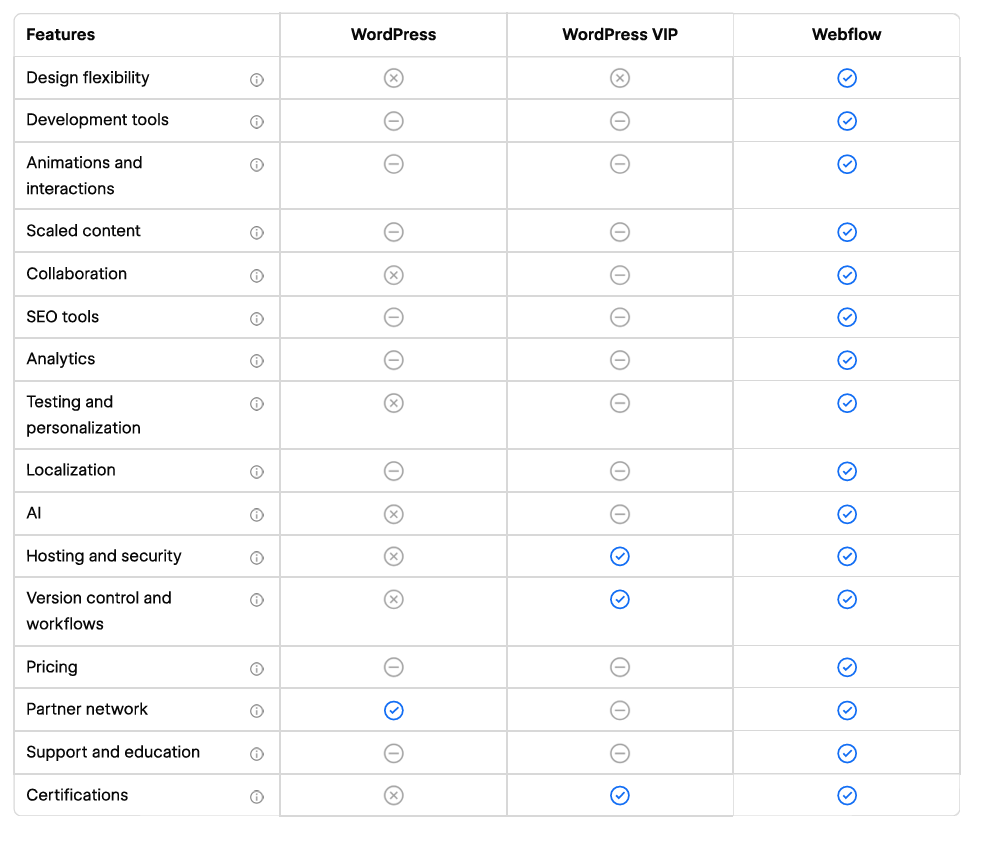
WordPress vs Webflow: the chart
This comes from Webflow, so it's going to favour Webflow. Read it as their view, not a neutral review.
Are there bad bits about Webflow?
Yes, nothing's perfect.
When you use a template, you can edit all the content but if you want to do more bespoke designs, you will need 'Designer' access, which A, comes at a cost (a paid seat on your Webflow workspace) and B, will take a bit of learning.
There are also limits on the CMS: how many items you can have, how many collections, and how many fields per collection. They depend on your plan, and Webflow lists them on its pricing page.
In practice this means that when you create a CMS page (similar to a post in WordPress), there is a cap on the fields you can edit on it, a cap on posts per collection, and a cap on collections (the equivalent of different post types in WordPress). For most marketing sites that's plenty. If yours is a big, interconnected directory, check the limits before you commit.
Why Webflow
Webflow sites are quicker to build, easier to manage and easier to hand over, and we don't work with WordPress. If you want to work with us, we'll move you to Webflow or Astro, whichever suits the site, and if you'd rather stay, we can point you to agencies that do it well. Get in touch and we'll talk it through.


More from the Content Hub
 How to make a free websiteYou can make a free website and own it. Here's how we built our own, pacing.agency, with AI coding tools and hosting that can cost nothing, step by step, and the parts that still cost money.Read the note
 The secret life of the user ID: what it is, why it matters, and when you can’t use itIf you're not using User IDs, do you really know what your website users are doing? Probably not.Read the note
 How we built 136 FAQs in minutes: the power of Cursor + Webflow MCPHow Cursor and Webflow's MCP server helped us create 136 FAQs for our website in minutes, and what we did first to make it work.Read the note
Get the next one in your inbox.
Occasional emails, only when there's something worth reading. You can unsubscribe from any of them.
Ready to get started?
Book in a free video call, a meeting in and around London, or even a running or climbing session.
- A 15-minute callYour goals, your challenges, and whether we're the right fit.
- A 1-hour discovery callWe dig into your numbers. Worth a hundred emails.
- A concrete planAds, a custom build or both, as a one-off project or ongoing.